How to review the open-closed principle in AI-written code
A new wallet method falls through a card default. Ask whether every payment method has an explicit outcome before merging.
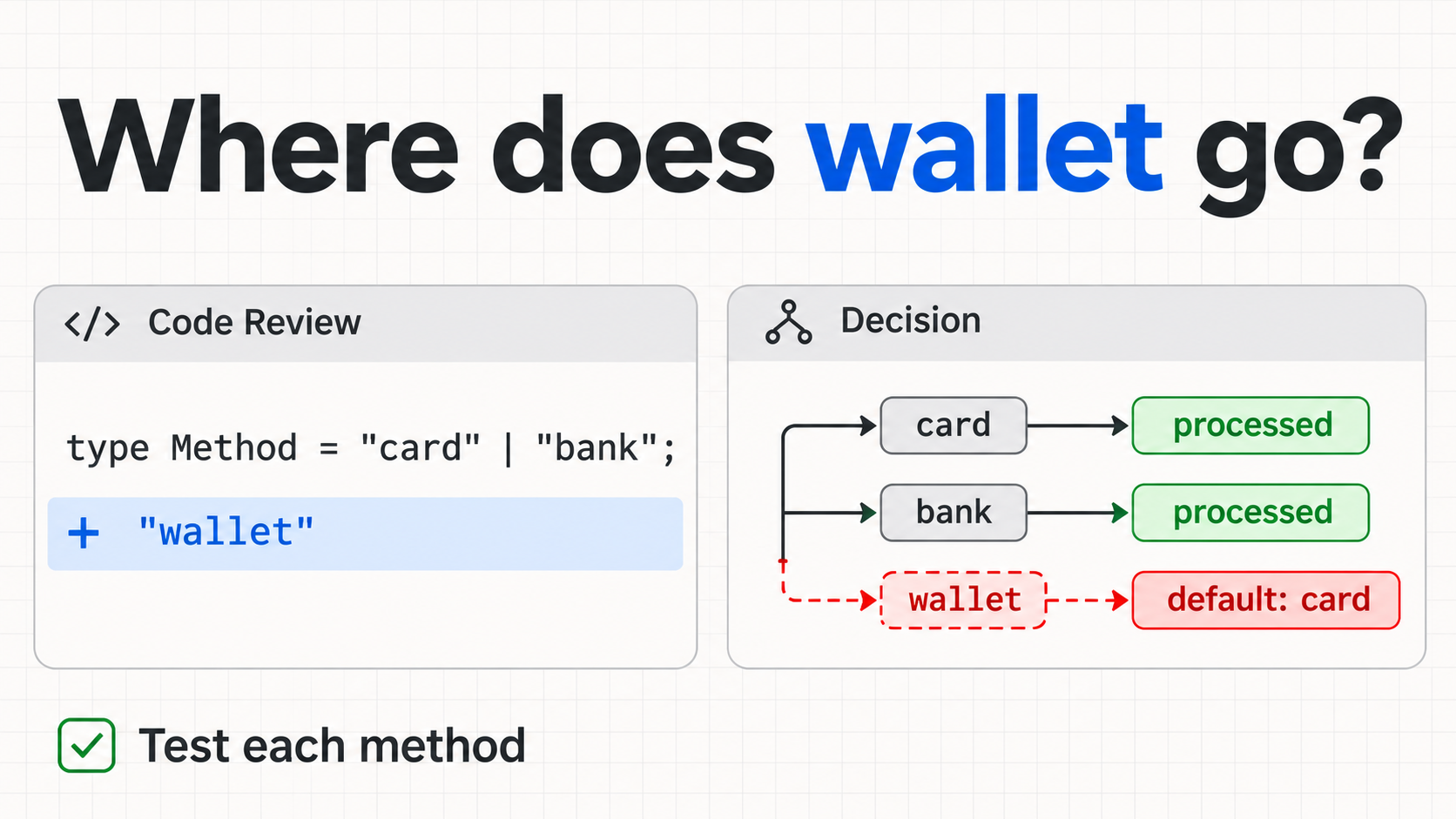
The open-closed principle is a useful review prompt when an AI-written change adds a new variant to a stable decision. It does not mean every switch must become a plugin system. It asks whether adding the variant can silently inherit behavior intended for an older one.
Consider a hypothetical checkout service. Card payments use a card processor. Bank payments start a bank transfer. An agent adds wallet to the public request type, but leaves the dispatcher unchanged. This is example application code, not Review Assist code.
Read the new variant against the old default
- type Method = "card" | "bank";+ type Method = "card" | "bank" | "wallet"; function startPayment(req: { method: Method }) { switch (req.method) { case "bank": return startBankTransfer(req); default: return chargeCard(req); } }The diff makes wallet a valid input, but the default sends it to chargeCard. The review question is: What should happen when method is wallet, and which test proves that path? Do not infer support from the new type alone. Trace the request from validation to this dispatch and the provider call.
Look for the product or payment contract that says whether wallet is supported now, rejected until a later release, or mapped to an existing processor on purpose. Then run a test with method: "wallet" that asserts the provider called and the response returned. Add a negative assertion that the card processor is not called if wallet has its own flow. A compile pass cannot settle this because the default accepts every future method too.
Decide how explicit the boundary needs to be
One repair is an explicit wallet case. If wallet is not ready, reject it at validation and keep it out of the public type until launch. An exhaustive switch with a never check can make the next new method fail typechecking, but only if the input is narrowed to the union and runtime validation rejects unknown strings. A handler registry may help when methods are independently deployed; for three stable methods it can add indirection without improving the decision.
A default is not automatically a defect. It may be an intentional fallback for a display-only label or a documented alias. Here it triggers a charge, so the cost of a wrong fallback is high. Also avoid demanding a new class for each method merely to satisfy a slogan. The principle is a review heuristic: make the new variant's behavior explicit at the boundary that acts on it.
Make the merge decision
Request changes for the hunk shown. Approve when the wallet contract is identified, the dispatcher or validation implements that contract, and a wallet-specific test proves the provider and failure result. If wallet intentionally uses the card processor, require a documented mapping and a test for that mapping. A green Review Assist coverage check shows that a hunk was explained, not that the payment decision is correct. The guided review can surface the assumption and its verification; the human reviewer still decides whether to merge.
Written by Udit Khandelwal, who builds Review Assist. Every claim here is meant to match the code; if one does not, open an issue.
Review AI-written code with its intent intact
Review Assist is free, open source, and stores none of your code.
Install Review Assist