How to review substitution in AI-written code
A cache-backed Store returns undefined on a miss although callers expect a record or NotFound. Review the replacement against the caller contract.
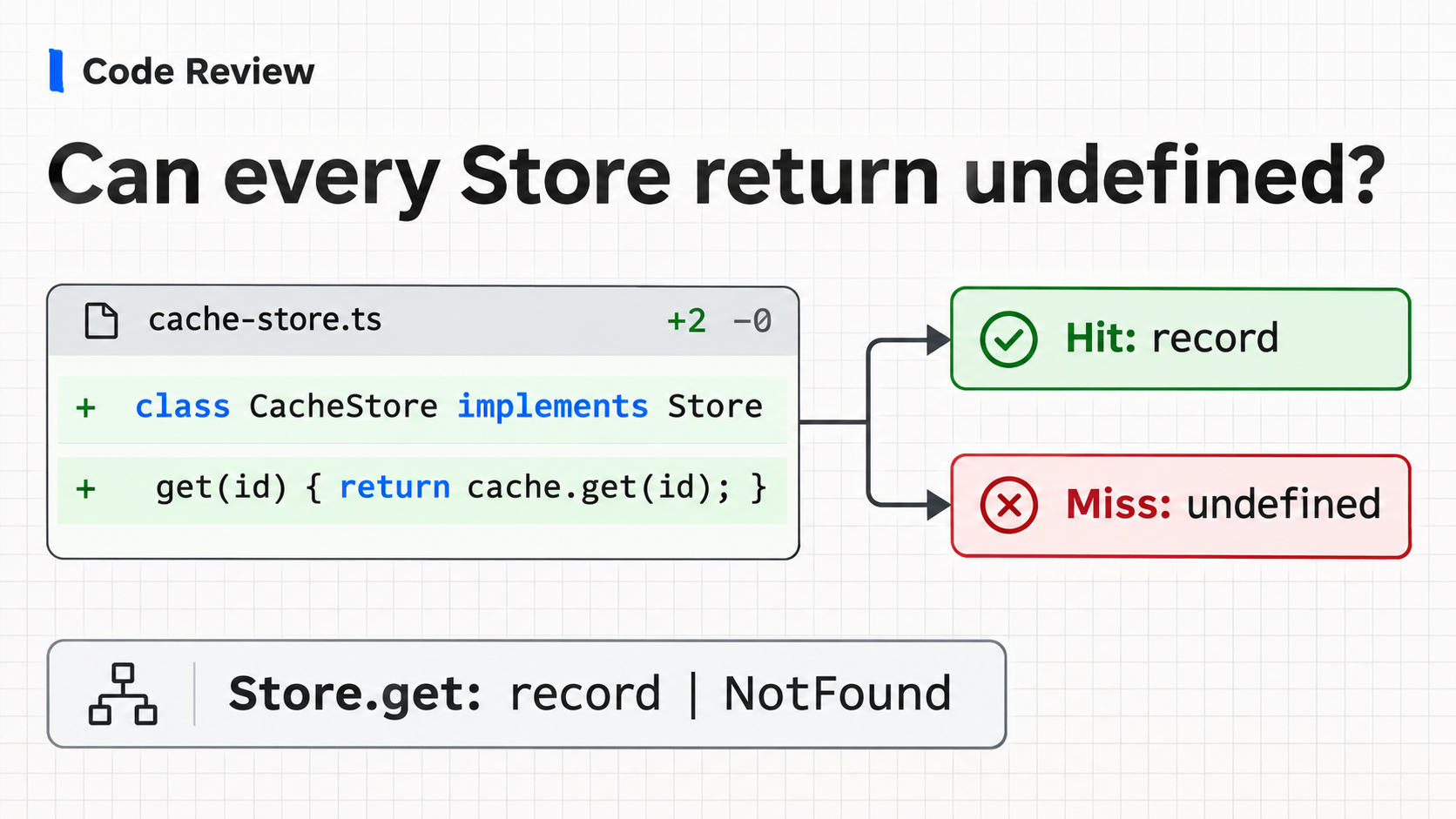
The Liskov substitution principle gives a reviewer one practical question: can the new implementation replace the old one without surprising its callers? An AI-written class may satisfy an interface name while changing a failure path that the interface does not spell out. Review the observable contract, not the inheritance diagram.
Consider a hypothetical service where Store.get(id) returns a record or throws NotFound. A route catches NotFound and sends HTTP 404. An agent adds a cache-backed implementation for the same Store port. This is example application code, not Review Assist code.
Read the miss path in the diff
interface Store { get(id: string): Promise<Item>; }+ class CacheStore implements Store {+ async get(id: string) {+ return cache.get(id);+ }+ } const record = await store.get(id); return sendJson(record);Assume cache.get returns undefined on a miss. The route now sends an empty or invalid success response instead of the established 404 path. A TypeScript check might catch this if the cache type accurately includes undefined and strict null checks are on. A loose cache client type, cast, or wrapper can hide it. The review question is: For a missing ID, does every Store implementation give the caller the same promised outcome?
Find the existing Store contract in documentation, tests, and call sites. Trace how the old implementation reports a missing ID, then run the same contract test against CacheStore: hit returns the right record; miss throws NotFound; the route maps that error to 404. If the cache is only an accelerator, a miss may instead load from the durable store and return that record. Test both the cache miss with a real record behind it and a genuinely absent ID. The evidence must show which behavior the service promises.
Separate a contract change from a replacement
Returning undefined is not inherently wrong. It can be a sound contract if all callers are written for Record | undefined and the API deliberately maps that case. But that is a change to the port and its consumers, not a drop-in replacement. Review every caller and update the contract tests before treating it as equivalent.
Do not flag a class solely because it uses a cache, retries, or throws a different internal error type. The relevant difference is what crosses the Store boundary. Conversely, passing one happy-path test does not establish substitutability. Error timing, missing-record behavior, and write visibility can matter when callers depend on them. Keep the review scoped to the contract this diff actually changes.
Make the merge decision
Request changes for the shown hunk until the miss path preserves the documented Store.get outcome or the port and all callers are deliberately migrated. Approve when shared contract tests run against both implementations and the route test proves the missing-ID response. The principle is a prompt to inspect a behavioral promise, not an automatic rejection of a new subtype.
In Review Assist, the anchored tour can point to the added get hunk, while the Intent Document's assumptions and verification fields can expose what the agent believed about cache misses and what it tested. The coverage check can show that the hunk has an explanation. It cannot prove the replacement obeys the caller contract; that decision still needs code and test evidence.
Written by Udit Khandelwal, who builds Review Assist. Every claim here is meant to match the code; if one does not, open an issue.
Review AI-written code with its intent intact
Review Assist is free, open source, and stores none of your code.
Install Review Assist